

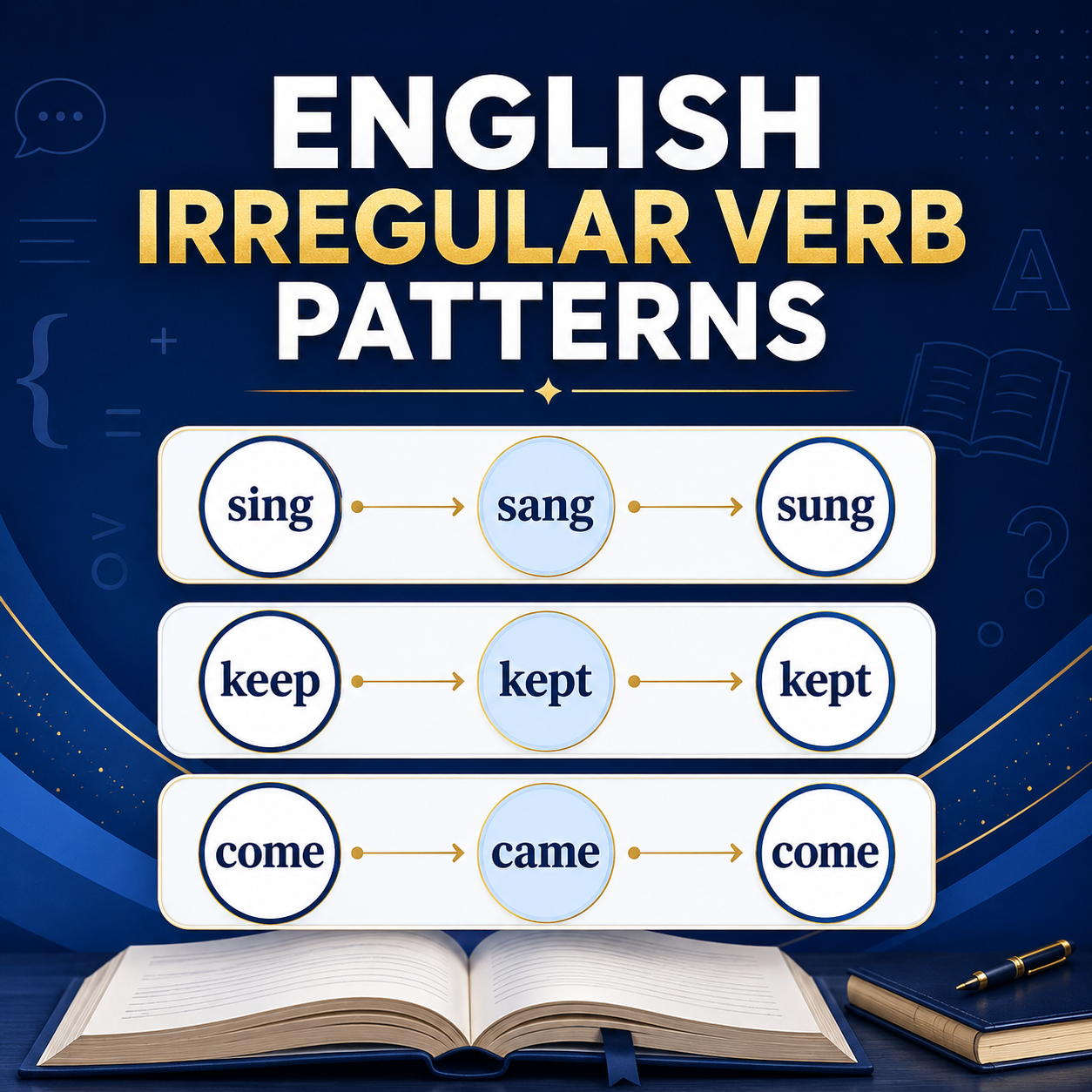
English irregular verbs are easier to remember when you stop treating them as one enormous alphabetical list. This guide groups common verbs by the changes they share, explains the important exceptions, and shows every pattern in real sentences.
Why Learning Irregular Verbs in Patterns Works Better
If you have searched for how to memorize irregular verbs, you have probably found long lists arranged from A to Z. An alphabetical list is useful as a reference, but alphabetical neighbours do not necessarily sound or behave alike. Begin and bend, for example, are close in a dictionary, but their forms follow different patterns.
begin → began → begun
bend → bent → bent
Grouping verbs by form creates smaller families. Therefore, instead of trying to remember three isolated words each time, you connect a new verb to a sound change you already recognise. Compare sing, sang, sung with ring, rang, rung. The second set becomes easier because the first set gives your memory a model.
However, these families are not productive grammar rules. In other words, you should not assume that every verb with a similar spelling changes in the same way. We say bring, brought, brought, not bring, brang, brung. The groups help you organise correct forms that you have checked.
For a single alphabetical reference, use our complete English irregular verbs list with Past Simple and Past Participle forms. This article has a different purpose: it turns that large list into memorable families.
The Five Main Irregular Verb Patterns
The letters A, B and C below represent forms, not grammar names. A repeated letter means that two forms are identical. Therefore, ABB means that the Past Simple and Past Participle are the same.
| Pattern | What happens | Example | What to remember |
|---|---|---|---|
| AAA | All three forms are identical. | cut → cut → cut | Context shows whether the action is present or past. |
| ABB | The two past forms match. | keep → kept → kept | Learn the base form plus one shared past form. |
| ABA | The Base Verb and Past Participle match. | come → came → come | The Past Simple is the only different form. |
| ABC | All three forms are different. | sing → sang → sung | Sound families can connect several verbs. |
| Unique | The verb has an exceptional history or structure. | go → went → gone | Learn very common exceptions separately. |
Search the Irregular Verb Groups
Type any Base Verb, Past Simple form or Past Participle below. The page will show the groups containing that form. For example, search for drank, known, sent or gone.
Pattern 1: Verbs That Do Not Change, AAA
In the AAA pattern, the Base Verb, Past Simple and Past Participle have the same written form. Therefore, time words and sentence structure tell you when the action happens.
Same Form in All Three Positions
Base Verb = Past Simple = Past Participle
| Base Verb | Past Simple | Past Participle | Example |
|---|---|---|---|
| cut | cut | cut | She cut the paper yesterday. |
| hit | hit | hit | The ball hit the window. |
| let | let | let | They let us enter early. |
| put | put | put | I put the keys on the table. |
| set | set | set | We set the alarm before bed. |
| shut | shut | shut | He shut the gate quietly. |
This family has several details and special cases. Therefore, see our separate guide to English verbs that do not change in the past tense.
Pattern 2: The Past Simple and Past Participle Match, ABB
This is one of the largest and most useful families. Once you know the shared past form, you can use it both as the Past Simple and after auxiliaries such as have, has and had.
The -eep to -ept Family
-eep → -ept → -ept
| Base Verb | Past Simple | Past Participle | Example |
|---|---|---|---|
| keep | kept | kept | She kept the receipt. |
| sleep | slept | slept | I slept for eight hours. |
| sweep | swept | swept | He swept the kitchen floor. |
| weep | wept | wept | She wept after hearing the news. |
A Final -d Often Becomes -t
send → sent → sent
| Base Verb | Past Simple | Past Participle | Example |
|---|---|---|---|
| bend | bent | bent | He bent the wire carefully. |
| build | built | built | They built the bridge in 2010. |
| lend | lent | lent | My friend lent me a book. |
| send | sent | sent | I sent the email this morning. |
| spend | spent | spent | We spent the weekend at home. |
The -ought and -aught Families
think → thought → thought
| Base Verb | Past Simple | Past Participle | Example |
|---|---|---|---|
| bring | brought | brought | She brought her laptop to class. |
| buy | bought | bought | They bought a new computer. |
| fight | fought | fought | The team fought until the end. |
| seek | sought | sought | She sought professional advice. |
| think | thought | thought | I thought the lesson was useful. |
| catch | caught | caught | He caught the last bus. |
| teach | taught | taught | She taught English for ten years. |
Other Common ABB Sound Families
Base Verb → one shared past form
| Base Verb | Past Simple | Past Participle | Example |
|---|---|---|---|
| feel | felt | felt | I felt much better yesterday. |
| find | found | found | We found the missing key. |
| hear | heard | heard | I heard a strange noise. |
| leave | left | left | They left before lunchtime. |
| lose | lost | lost | He lost his wallet on the train. |
| sell | sold | sold | They sold the old car. |
| tell | told | told | She told me the truth. |
| win | won | won | Our team won the match. |
Pattern 3: Vowel Changes Across the Three Forms, ABC
Many older English verbs change a vowel inside the word. These are sometimes called strong verbs. The forms are irregular in modern English, but the repeated sound relationships make them easier to organise.
The I, A, U Pattern
sing → sang → sung
| Base Verb | Past Simple | Past Participle | Example |
|---|---|---|---|
| begin | began | begun | The meeting began at nine. |
| drink | drank | drunk | She drank a glass of water. |
| ring | rang | rung | The phone rang during class. |
| sing | sang | sung | They sang my favourite song. |
| sink | sank | sunk | The boat sank near the coast. |
| swim | swam | swum | We swam across the pool. |
The -oke and -oken Family
speak → spoke → spoken
| Base Verb | Past Simple | Past Participle | Example |
|---|---|---|---|
| break | broke | broken | She broke her glasses yesterday. |
| choose | chose | chosen | They chose the blue design. |
| freeze | froze | frozen | The lake froze overnight. |
| speak | spoke | spoken | I spoke to the manager. |
| steal | stole | stolen | Someone stole his bicycle. |
| wake | woke | woken | I woke before the alarm. |
The I, O, I plus -en Pattern
write → wrote → written
| Base Verb | Past Simple | Past Participle | Example |
|---|---|---|---|
| drive | drove | driven | She drove to work yesterday. |
| ride | rode | ridden | He rode his bike to school. |
| rise | rose | risen | Prices rose again last month. |
| write | wrote | written | She wrote a detailed report. |
The -ew to -own or -awn Family
know → knew → known
| Base Verb | Past Simple | Past Participle | Example |
|---|---|---|---|
| blow | blew | blown | The wind blew all night. |
| draw | drew | drawn | The child drew a picture. |
| fly | flew | flown | We flew to London last year. |
| grow | grew | grown | The company grew very quickly. |
| know | knew | known | I knew the answer immediately. |
| throw | threw | thrown | He threw the ball to me. |
Pattern 4: The Base Verb and Past Participle Match, ABA
This is a small but important group. The Past Simple changes, while the Past Participle returns to the Base Verb form.
Come, Become and Run
A → B → A
| Base Verb | Past Simple | Past Participle | Example |
|---|---|---|---|
| become | became | become | She became a teacher in 2015. |
| come | came | come | They came home late. |
| run | ran | run | He ran five kilometres yesterday. |
Past Simple: She came early yesterday.
Present Perfect: She has come early several times.
If the difference between these two tenses is still unclear, read our guide to the Present Perfect and its connection between the past and the present.
Pattern 5: High-Frequency Verbs with Unique Forms
Some of the most frequent verbs do not fit neatly into a large sound family. Because they appear so often, learning them separately gives you a strong return for your study time.
Common Exceptions to Learn First
Learn as complete three-part units
| Base Verb | Past Simple | Past Participle | Example |
|---|---|---|---|
| be | was / were | been | They were at home last night. |
| do | did | done | I did my homework after dinner. |
| go | went | gone | We went to the museum. |
| have | had | had | She had a meeting at ten. |
| make | made | made | He made a serious mistake. |
| see | saw | seen | I saw her at the station. |
| take | took | taken | They took the earlier train. |
How to Memorize Irregular Verbs Without Learning One Giant List
The best answer to how to memorize irregular verbs is not to avoid memorisation completely. Instead, make the task smaller, more organised and connected to real language. Patterns reduce the number of isolated forms, while sentences show you how those forms behave.
Download the Free Irregular Verbs Memory Guide PDF
Use this printable workbook to study English irregular verb patterns, practise Past Simple and Past Participle forms, and review the verbs through active recall. Choose your preferred language below.
International English edition with 62 verbs, meanings, examples, a seven-day plan, exercises and an answer key.
Portuguese edition with the same 62 English irregular verbs, translations, examples, exercises and answer key.
1. Learn One Family at a Time
Choose four to six related verbs. For example, study sing, ring, drink, sink and swim together before moving to another sound family.
2. Say All Three Forms Aloud
Use a steady rhythm: sing, sang, sung. Hearing the vowel sequence creates another memory path in addition to seeing the spelling.
3. Attach Each Verb to a Sentence
Do not stop at drink, drank, drunk. Add a useful sentence: I drank some water after the lesson.
4. Contrast Past Simple and Past Participle
Write two sentences: I spoke to her yesterday and I have spoken to her before. The contrast gives each form a grammatical job.
5. Retrieve Before You Check
Cover the two past forms and try to produce them from memory. Checking immediately feels easier, but retrieval is the part that trains recall.
6. Review at Increasing Intervals
Review the family later the same day, then after one day, three days and one week. Short repeated reviews are more manageable than one long session.
A Simple Seven-Day Study Plan
| Day | Study focus | Practical task |
|---|---|---|
| Day 1 | AAA verbs | Write six past-tense sentences with cut, put, hit, let, set and shut. |
| Day 2 | -ept and final -t groups | Say the forms aloud and create a short story with kept, slept, sent and spent. |
| Day 3 | -ought and -aught groups | Contrast bought, brought, thought, caught and taught. |
| Day 4 | I, A, U verbs | Practise began, drank, rang, sang, sank and swam. |
| Day 5 | Past participles ending in -en or -n | Use spoken, written, driven, known and grown after have or has. |
| Day 6 | ABA and unique verbs | Review come, came, come, run, ran, run, go, went, gone and be, was/were, been. |
| Day 7 | Mixed retrieval | Test yourself without looking, then review only the forms you missed. |
Common Mistakes When Applying Patterns
Patterns are useful only when they lead to standard forms. Therefore, always separate a remembered family from a form you have invented by analogy.
- Incorrect: bring, brang, brung
Correct: bring, brought, brought - Incorrect: think, thank, thunk
Correct: think, thought, thought - Incorrect: teach, teached, teached
Correct: teach, taught, taught - Incorrect: write, wrote, wrote
Correct: write, wrote, written - Incorrect: come, came, came
Correct: come, came, come - Incorrect: go, went, went
Correct: go, went, gone
Practice: Can You Recognise the Pattern?
1. Complete: Yesterday, she ___ a song. (sing)
Answer: Yesterday, she sang a song. The Past Simple of sing is sang.
2. Complete: I have ___ this book before. (read)
Answer: I have read this book before. The spelling is unchanged, although the Past Participle is pronounced /red/.
3. Complete: They ___ the message yesterday. (send)
Answer: They sent the message yesterday. Send belongs to the final -d to -t group.
4. Complete: He has ___ to London twice. (fly)
Answer: He has flown to London twice. After has, we need the Past Participle.
5. Correct the mistake: Did you went to class?
Answer: Did you go to class? The auxiliary did already marks the past, so the main verb returns to its Base Verb form.
6. Correct the mistake: She has wrote three emails.
Answer: She has written three emails. The forms are write, wrote, written.
Final Summary
Irregular verbs are not one completely random collection. Many can be organised into recurring families such as AAA, ABB, ABA and ABC. Learning sing, sang, sung beside ring, rang, rung, or keep, kept, kept beside sleep, slept, slept, reduces the number of isolated forms your memory must manage.
However, a pattern is a memory aid, not permission to invent a verb form. Learn a small family, say the forms aloud, use them in sentences, retrieve them without looking and review them over several days. That combination makes irregular verbs useful in real English instead of leaving them as words in a table.
Frequently Asked Questions
What is the easiest way to memorize irregular verbs?
Group verbs with similar forms, learn only a few at a time, say all three forms aloud and use each verb in a sentence. Then test yourself before checking the answer and review the same group at increasing intervals.
Do all irregular verbs follow a pattern?
No. Many verbs share useful similarities, but common verbs such as go, went, gone and be, was/were, been need special attention. Patterns organise confirmed forms; they do not predict every verb.
What do AAA, ABB, ABA and ABC mean?
The letters compare the Base Verb, Past Simple and Past Participle. AAA means all three forms match. ABB means the two past forms match. ABA means the Base Verb and Past Participle match. ABC means all three forms differ.
Why is grouping better than an alphabetical list?
An alphabetical list is excellent for checking a verb, but nearby entries may have unrelated forms. Grouping creates sound and spelling connections, so one familiar sequence can help you recall several verbs.
Should I learn the Past Simple and Past Participle together?
Yes. The Past Simple is used for completed past actions, while the Past Participle appears in structures such as the Present Perfect, Past Perfect and passive voice. Learning both prevents mistakes such as has went or has wrote.
How many irregular verbs should I study each day?
A small group of four to eight related verbs is usually more manageable than a long list. The important point is to retrieve and use the verbs, not simply read many forms once.