


How to Say Prices in English: Formal, Informal, and Native-Sounding Ways
Talking about prices in English is a daily-life skill. However, many learners feel insecure because prices can be said in different ways, depending on the situation. For this reason, understanding both the formal and the informal forms is essential.
In this guide, you will learn:
- the formal way to say prices
- the Informal way native speakers use every day
- how Americans say large prices
- and common shortcuts you will hear in real conversations

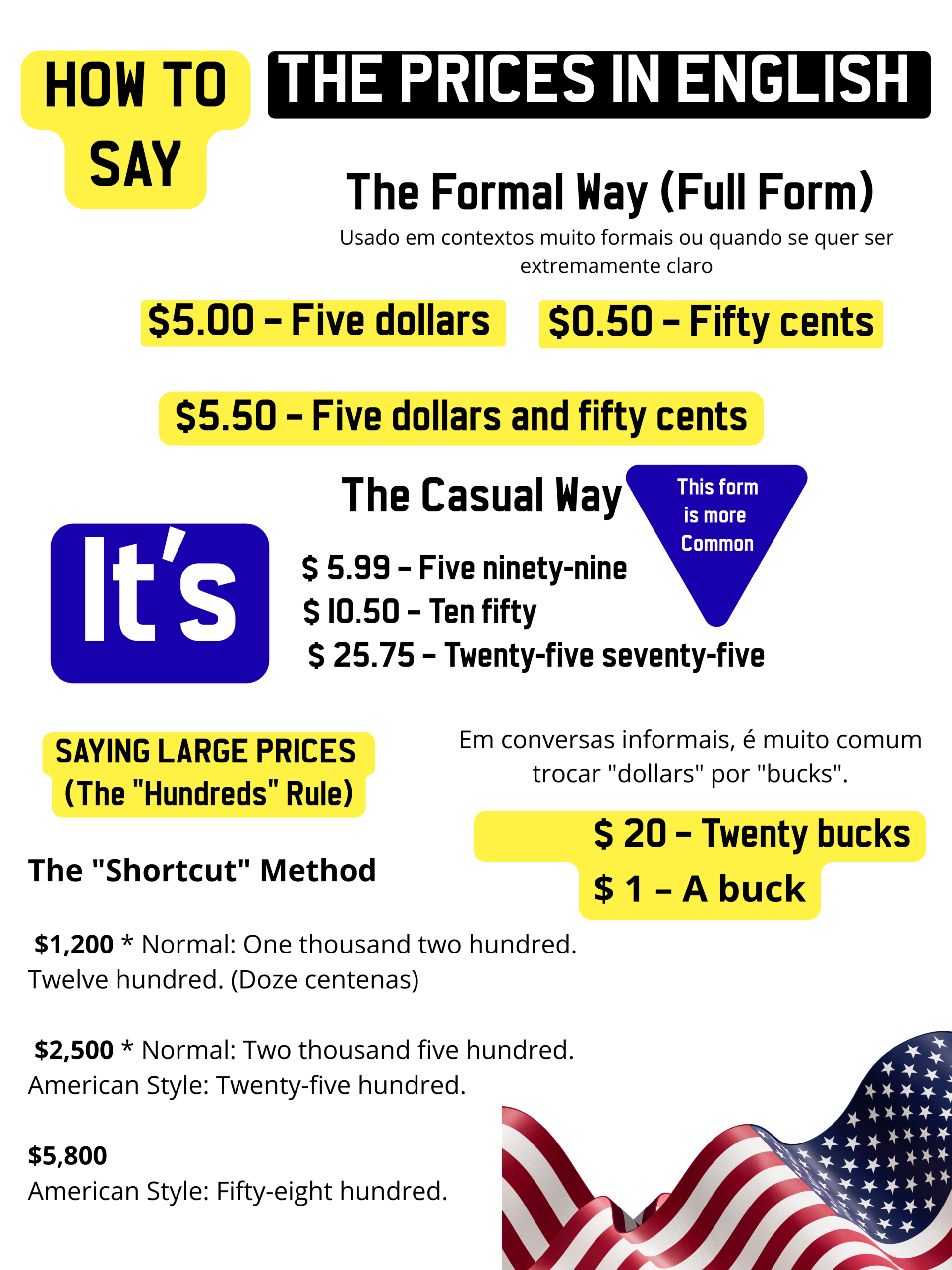
The Formal Way to Say Prices (Full Form)
First of all, let’s start with the formal structure. This form is used in very formal contexts, announcements, presentations, or whenever you want to be extremely clear.
In this case, you say the currency name in full.
Examples:
- $5.00 → five dollars
- $0.50 → fifty cents
- $5.50 → five dollars and fifty cents
As you can see, this structure leaves no room for confusion. Therefore, it is ideal for formal communication.
The informal Way to Say Prices (Most Common in Real Life)
Now, let’s move on to the way native speakers actually talk.
In everyday conversations, people usually drop the words “dollars” and “cents”. Instead, they say the numbers directly.
Examples:
- $5.99 → five ninety-nine
- $10.50 → ten fifty
- $25.75 → twenty-five seventy-five
Because this form is shorter and faster, it is by far the most common in stores, restaurants, and informal conversations.
Saying Prices with “Bucks” (Very Informal)
In informal American English, people often replace dollars with bucks.
For example:
- $1 → a buck
- $20 → twenty bucks
This expression is extremely common. However, it should be avoided in formal situations.
Saying Large Prices in English (The “Hundreds” Rule)
At this point, many learners get confused. Nevertheless, large prices follow a very logical pattern, especially in American English.
The “Shortcut” Method for Large Prices
Instead of saying the full number, Americans often group prices by hundreds.
Example 1: $1,200
- Normal form: one thousand two hundred
- Informal American form: twelve hundred
Here, you simply think:
- 12 × 100 = 1,200
Example 2: $2,500
- Normal form: two thousand five hundred
- American style: twenty-five hundred
Again, the logic is clear:
- 25 × 100 = 2,500
Example 3: $5,800
- Normal form: five thousand eight hundred
- Informal American style: fifty-eight hundred
This shortcut sounds extremely natural and is widely used when talking about prices, rent, salaries, and cars.
When Should You Use Each Form?
In short:
- Use the full form when you need clarity or formality
- Use the informal number form in daily conversations
- Use bucks only in informal contexts
- Use the hundreds rule to sound natural with large prices
Final Thoughts
In conclusion, saying prices in English is not difficult once you understand the patterns. Instead of translating word by word, focus on how native speakers group numbers and simplify speech.
With practice, these structures become automatic — and your English immediately sounds more natural.