




ED Pronunciation in English: a clear and practical guide
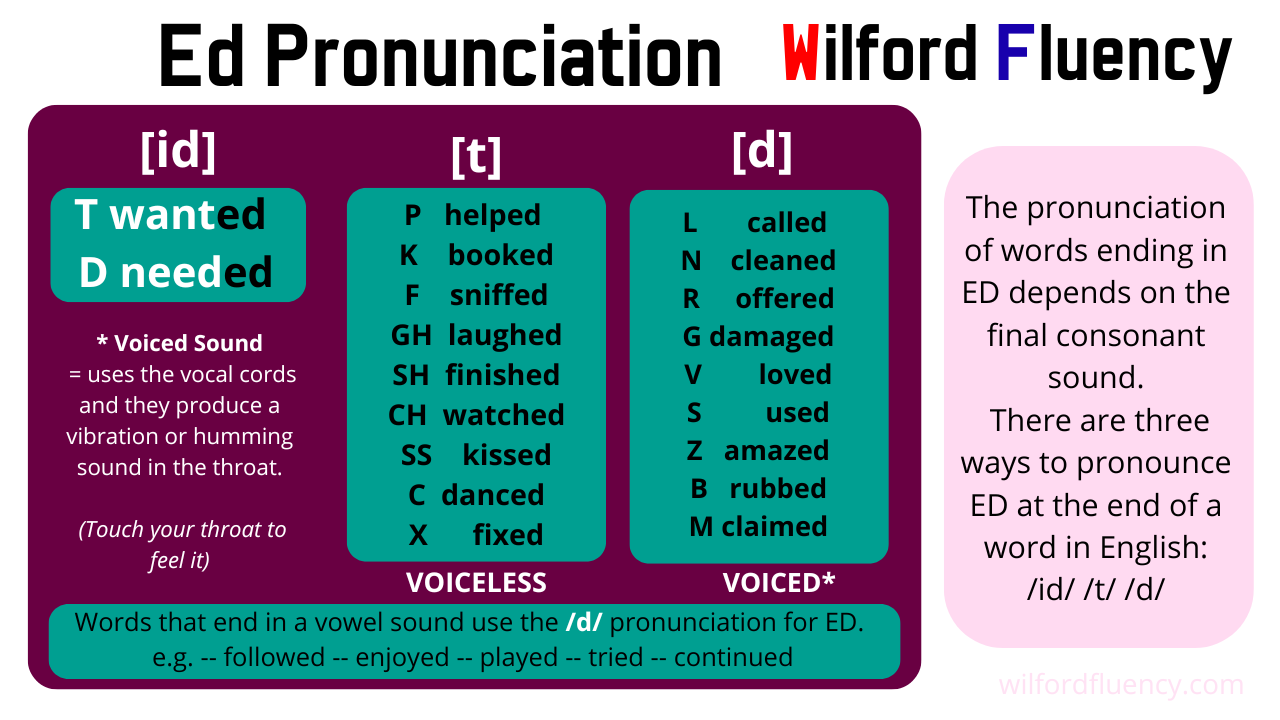
The pronunciation of -ed endings in English is one of the most common difficulties for learners, especially when speaking in the past tense. Although many people believe that -ed is always pronounced as /id/, this is not true.
In fact, regular verbs in the past tense have three different pronunciations for the -ed ending. Therefore, understanding these rules is essential for clear and natural spoken English.
Why does the pronunciation of -ed change?
First of all, it is important to understand one key rule.
The pronunciation of -ed does not depend on spelling, but on the final sound of the verb, not the final letter.
In other words, what matters is the last sound you hear, not what you see written.
Below, you will learn the three possible pronunciations of -ed, explained step by step.
Pronunciation of -ed as /id/
To begin with, -ed is pronounced as /id/ when the verb ends in the sound of /t/ or /d/.
In these cases, English adds an extra syllable to make pronunciation easier.
When does this happen?
It happens when the verb ends with:
- the sound of T
- the sound of D
Common examples
- want → wanted
Pronunciation: /ˈwɒn.tɪd/ - need → needed
Pronunciation: /ˈniː.dɪd/ - decide → decided
Pronunciation: /dɪˈsaɪ.dɪd/
In all these examples, the -ed ending creates an extra syllable.
See pronunciation with decided
See pronunciation with needed
Pronunciation of -ed as /t/
Secondly, -ed is pronounced as /t/ when the verb ends in a voiceless sound. These are sounds that do not vibrate the vocal cords.
A simple test is to place your hand on your throat. If you feel no vibration, the sound is voiceless.
Sounds that lead to /t/
Common voiceless sounds include:


Real-life examples
- work → worked
Pronunciation: /wɜːkt/ - help → helped
Pronunciation: /helpt/ - watch → watched
Pronunciation: /wɒtʃt/ - laugh → laughed
Pronunciation: /lɑːft/ - kiss→ kissed
Pronunciation: /kisst/
In these cases, the -ed ending does not form a new syllable. It is pronounced as a short /t/ sound.
Work → worked
Kiss→ kissed
Pronunciation of -ed as /d/
Finally, -ed is pronounced as /d/ when the verb ends in a voiced sound, meaning the vocal cords vibrate.
This is the most common pronunciation of the -ed ending.
Sounds that lead to /d/
These include:


- vowel sounds in general
Common examples
- call → called
Pronunciation: /kɔːld/ - clean → cleaned
Pronunciation: /kliːnd/ - love → loved
Pronunciation: /lʌvd/ - play → played
Pronunciation: /pleɪd/ - open → opened
Pronunciation: /opend/
Here, the -ed ending blends smoothly with the verb and does not add an extra syllable.
What about verbs ending in vowel sounds?
In addition, whenever a verb ends in a vowel sound, the -ed ending is pronounced as /d/.
Examples
- enjoy → enjoyed
- play → played
- continue → continued
Therefore, vowel-ending verbs follow the same rule as voiced sounds.
Common mistakes with -ed pronunciation
One very common mistake among learners is pronouncing every -ed ending as /id/.
Incorrect: worked pronounced as /ˈwɜː.kɪd/
Correct: worked pronounced as /wɜːkt/
Incorrect: called pronounced as /ˈkɔː.lɪd/
Correct: called pronounced as /kɔːld/
Avoiding this mistake will greatly improve both your pronunciation and your listening comprehension.
Final thoughts
To sum up, the pronunciation of -ed in English follows three clear rules:
- /id/ after sounds of T and D
- /t/ after voiceless sounds
- /d/ after voiced sounds and vowels
By focusing on the final sound of the verb, you can dramatically improve your spoken English and sound much more natural.
Mastering -ed pronunciation is an essential step for anyone who wants to speak English clearly and confidently.