


What’s the Difference Between Everyday and Every Day?
In English, small changes in word form often lead to meaningful differences in usage. For this reason, the expressions everyday and every day cause confusion for many learners. Although they look almost identical, English uses them in very different grammatical roles. Understanding this difference helps you write more accurately and avoid mistakes that immediately stand out.
More importantly, English relies heavily on word position and structure to signal meaning. Because of that, knowing whether a word functions as an adjective or as an adverbial expression becomes essential. This distinction explains exactly why everyday and every day are not interchangeable.
Understanding the Basic Difference
At its core, the difference comes down to function.
-
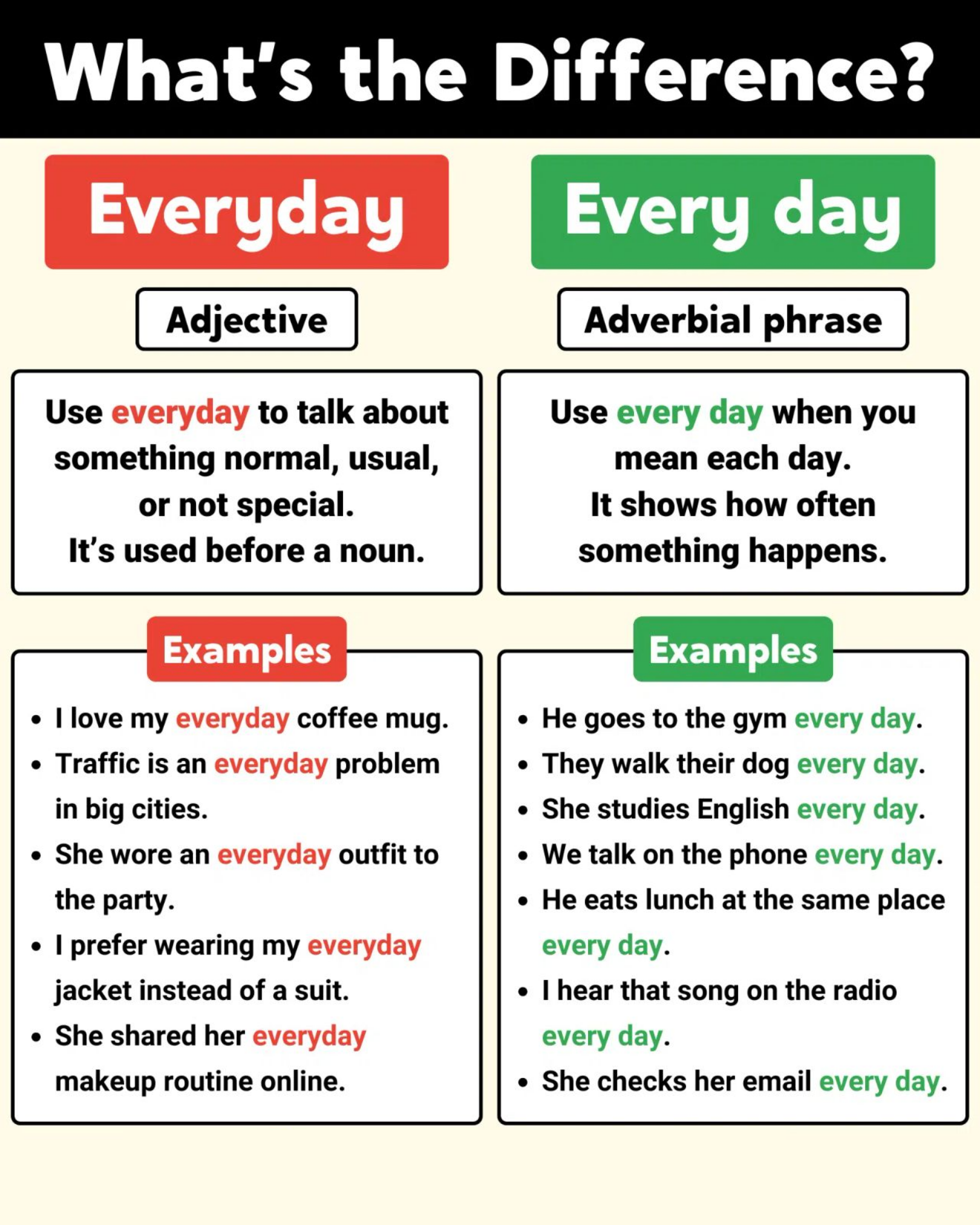
Everyday (one word) works as an adjective.
-
Every day (two words) works as an adverbial phrase.
Once you identify what role the expression plays in the sentence, the correct choice becomes clear.
When to Use “Everyday” (Adjective)
We use everyday to describe something that is ordinary, routine, or common. Because it is an adjective, it always comes before a noun.
In other words, everyday answers the question:
👉 What kind of thing is it?
Examples
She wears everyday clothes to work.
These are everyday problems.
This app helps with everyday tasks.
In each example, everyday modifies a noun (clothes, problems, tasks). Therefore, it cannot stand alone and must always describe something.
When to Use “Every Day” (Adverbial Phrase)
In contrast, we use every day to describe how often something happens. This expression refers to frequency and answers the question:
👉 How often?
Because of this, every day usually appears at the end of a sentence, although it can also appear at the beginning for emphasis.
Examples
I exercise every day.
She checks her email every day.
Every day, he wakes up early.
Here, every day tells us about repetition and routine over time. As a result, it modifies the verb, not a noun.
A Simple Test That Always Works
Whenever you feel unsure, try this quick test:
Replace the word with “daily.”
-
If daily fits, use every day.
-
If daily does not fit, use everyday.
For example:
-
I go for a walk daily → I go for a walk every day
-
These are daily shoes ✖ → These are everyday shoes ✔
Common ESL Mistakes to Avoid
Because the two forms look similar, learners often mix them up.
❌ I go to the gym everyday.
✔️ I go to the gym every day.
❌ These are shoes I wear every day shoes.
✔️ These are everyday shoes.
In most cases, the mistake happens when the writer forgets to check whether the word is describing a noun or a verb.
Why This Difference Matters in Writing
Although readers may understand both versions, incorrect usage can make your writing look careless. For this reason, mastering pairs like everyday and every day improves clarity and professionalism, especially in emails, academic writing, and content creation.
Moreover, English uses many similar pairs (anytime vs any time, anyone vs any one), so learning this pattern helps beyond just this example.
This is just one of many tricky word pairs in English.
👉 Explore the full guide to common English confusions. Common English Confusions: What’s the Difference Between Similar Words?
Quick Recap
Everyday:
-
one word
-
adjective
-
describes something ordinary
Every day:
-
two words
-
adverbial phrase
-
describes frequency
Final Summary
In short, everyday and every day serve different grammatical purposes.
We use everyday to describe things that are ordinary or routine.
We use every day to say that something happens daily.
Once you focus on function instead of spelling, choosing the correct form becomes natural and automatic.
