


Uncountable Nouns in English: How to Use Them Correctly
Many ESL learners ask the same questions when studying English grammar: What are uncountable nouns in English? Why are words like information and advice uncountable? Can we say an information or advices? How do you quantify uncountable nouns correctly? What does “a piece of information” mean? How do I know if a noun is countable or uncountable? These are some of the most searched questions online, and understanding them is essential for using English naturally and accurately.
Uncountable nouns in English are one of the most common search topics among ESL learners. However, they are also one of the most confusing areas of English grammar. Many learners struggle because, in other languages, these nouns can be plural and counted easily. English, on the other hand, follows a different system that focuses more on meaning than on physical quantity.
From the point of view of English grammar, uncountable nouns represent ideas, substances, or collections that English sees as a whole. Although these nouns may refer to multiple elements, English does not separate them into individual units. Because of this, they do not have plural forms and are always treated as singular.
Another important point is that uncountable nouns are not random. English consistently treats certain concepts—such as knowledge, advice, tools, or travel items—as collective ideas. Therefore, words like information, advice, equipment, luggage, and baggage follow fixed patterns that appear again and again in real usage.
However, this does not mean English cannot express quantity. Instead of using numbers directly, English relies on quantifying expressions. These expressions allow speakers to refer to portions, parts, or units without changing the noun itself. This is why English prefers structures like a piece of or a bit of rather than plural forms.
For this reason, understanding uncountable nouns is not just a grammar rule to memorize. It is a way to understand how English organizes meaning. Once learners stop translating word for word and start using these structures naturally, their English becomes clearer, more accurate, and more confident.
How English Quantifies Uncountable Nouns
Because uncountable nouns cannot be counted directly, English uses particles and container expressions to show quantity. These expressions act as countable units while the noun itself remains uncountable.
Common quantifying expressions include:
-
a piece of / pieces of
-
a bit of
-
an item of / items of
-
some
-
a lot of
The noun does not change. Only the quantifier does.
Examples with Common Uncountable Nouns
Information
I need some information about the course.
She shared a piece of information with me.
They found two pieces of information online.
Advice
He gave me some advice.
Let me give you a piece of advice.
She received several pieces of advice from her mentor.
Equipment
-
The company bought new equipment.
-
This machine is a piece of equipment used in the lab.
-
The gym added three new items of equipment.
Luggage
-
My luggage is very heavy.
-
I’m travelling with one piece of luggage.
-
She checked two items of luggage at the airport.
Baggage
-
His baggage was delayed.
-
Each passenger is allowed one item of baggage.
-
They arrived with several pieces of baggage.
How to Check If a Noun Is Countable or Uncountable
A very effective strategy when learners search “Is this word countable or uncountable?” is to consult a learner’s dictionary, especially the Cambridge Dictionary.
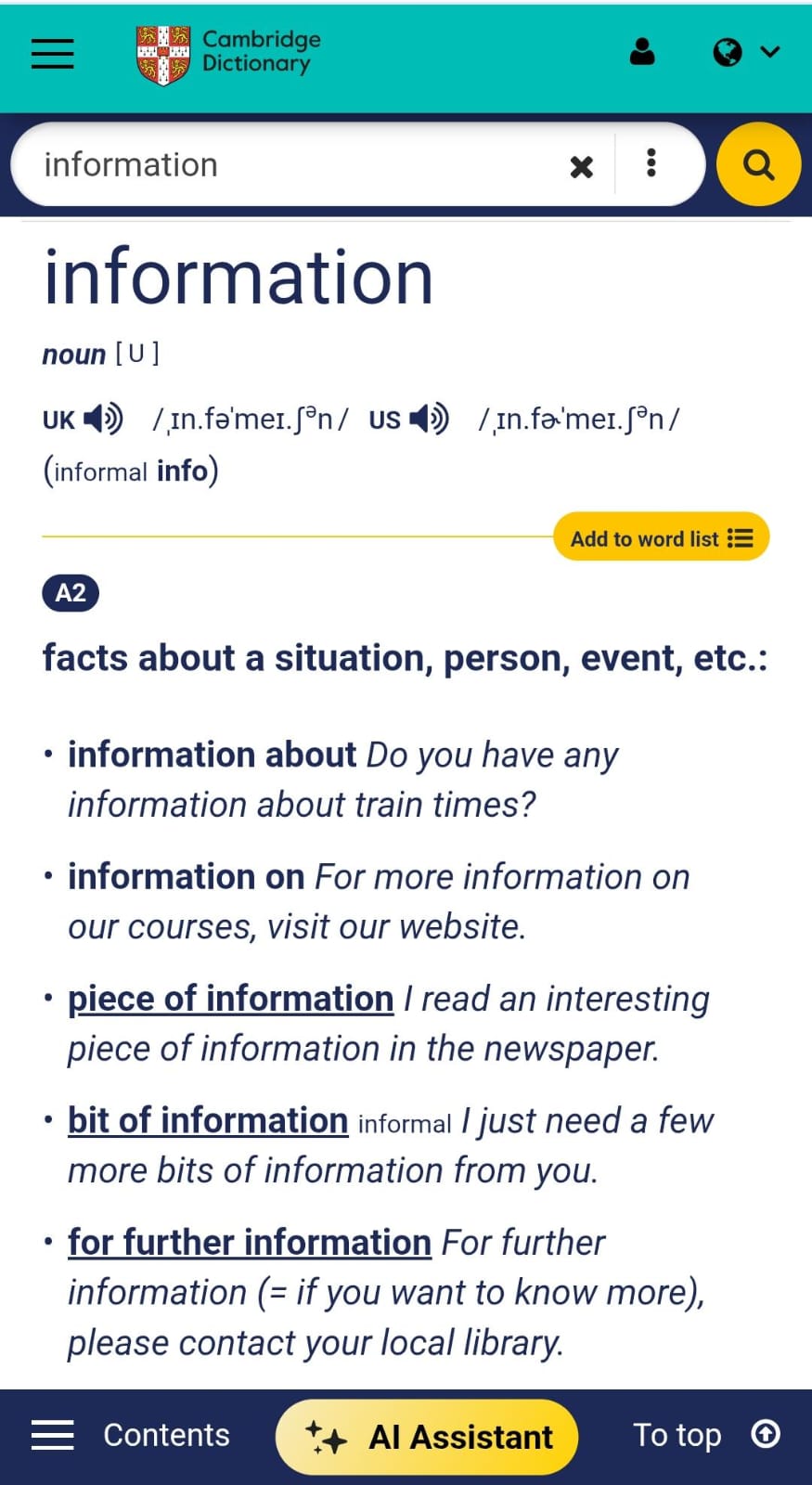
Next to each noun, Cambridge shows:
-
[U] for uncountable
-
[C] for countable
-
[C or U] when both are possible
Final Tip
If you cannot use a number directly with a noun, do not force a plural form. Instead, choose a natural quantifier like a piece of, a bit of, or an item of. This approach reflects how English is actually spoken and written.
Mastering uncountable nouns is a key step toward accurate and natural English.
