

What’s the Difference Between Shadow and Shade?
The words shadow and shade are often confused because both are related to light and darkness. In many situations, they seem interchangeable, but in English they are used with different meanings and perspectives.
The difference is not just about darkness. It’s about how the darkness is created and how it is used or perceived.
How We Use the Word “Shadow”
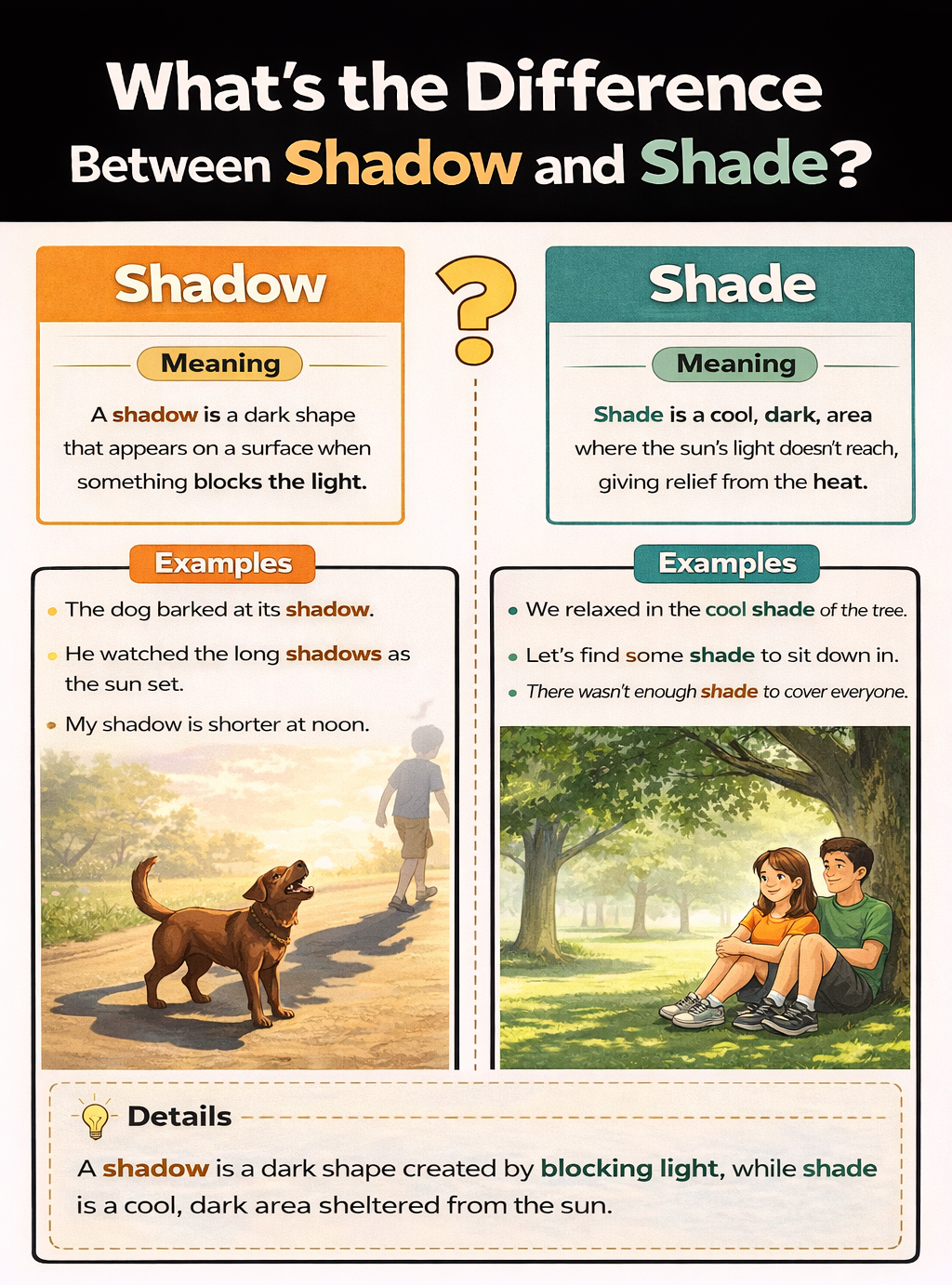
We use shadow to talk about a dark shape that appears when an object blocks light. A shadow is usually a clear outline or silhouette caused by something standing between the light source and a surface.
We say shadow when the focus is on:
-
the shape created by blocked light
-
contrast between light and dark
-
something being cast or projected
Examples of How We Say It
The tree cast a long shadow on the ground.
The shape of the tree is visible.
I could see his shadow on the wall.
The shadow is a dark outline.
Her shadow moved as she walked past the window.
The darkness follows the object.
So, shadow refers to the result of light being blocked, often with a visible form.
How We Use the Word “Shade”
We use shade to describe an area protected from direct sunlight. Shade is about comfort and shelter, not shape.
We say shade when the focus is on:
-
protection from the sun
-
cooler areas
-
places where light is reduced
Examples of How We Say It
Let’s sit in the shade.
This means away from direct sunlight.
The children played in the shade of the trees.
The area is cooler and more comfortable.
This plant grows well in partial shade.
Shade refers to light conditions, not a shape.
So, shade is about relief from sunlight, not a visible outline.
Shadow vs Shade in Everyday English
The difference becomes clear when we compare them directly.
A shadow is a shape created by blocked light.
Shade is an area where sunlight is reduced.
Shadows are visual.
Shade is practical and functional.
You see a shadow.
You sit or stay in the shade.
A Simple Way to Remember the Difference
This simple rule helps ESL students a lot:
-
If you can see a shape → shadow
-
If you are escaping the sun → shade
This guideline works in most everyday situations.
Common ESL Mistakes to Avoid
❌ Let’s sit in the shadow.
✔️ Let’s sit in the shade.
❌ The lamp made a shade on the wall.
✔️ The lamp made a shadow on the wall.
Another common issue is using shadow when talking about temperature or comfort.
Remember:
-
comfort from the sun → shade
-
dark outline → shadow
Other Common Uses of “Shadow”
Shadow is also used in more abstract or figurative ways.
Examples:
-
He lives in his brother’s shadow.
-
The past cast a shadow over his career.
In these cases, shadow suggests influence, presence, or something negative affecting a situation.
Other Common Uses of “Shade”
Shade can also be used figuratively, especially in informal contexts.
Example:
-
She was throwing shade at her coworker.
Here, shade means subtle criticism or disrespect, especially in modern spoken English.
Quick Recap
Shadow:
-
dark shape
-
result of blocked light
-
visible outline
Shade:
-
area protected from sunlight
-
cooler and more comfortable
-
about shelter, not shape
Final Summary
Although shadow and shade are related to light and darkness, they are not interchangeable in English.
We use shadow for the dark shape created when light is blocked.
We use shade for areas that provide protection from direct sunlight.
Understanding this difference helps you describe scenes more accurately and sound more natural in everyday English.
Learning English is easier when you understand these distinctions.
👉 Read our full guide to common English confusions.
