
Close Menu
Wilford Flunecy
    Wilford Flunecy
    Button
    • Home
    • Expressions

      Fluência em inglês não é perfeição é comunicação

      16 de December de 2025

      Balls up o que quer dizer esse Phrasal Verb?

      16 de December de 2025

      To be on the safe side: significado, uso e exemplos em inglês

      15 de December de 2025

      Take it easy: significado, uso e exemplos em inglês

      15 de December de 2025
    • Tricky English
      1. Expressions
      2. English for Travel
      3. Grammar
      4. View All

      Fluência em inglês não é perfeição é comunicação

      16 de December de 2025

      Balls up o que quer dizer esse Phrasal Verb?

      16 de December de 2025

      To be on the safe side: significado, uso e exemplos em inglês

      15 de December de 2025

      Take it easy: significado, uso e exemplos em inglês

      15 de December de 2025

      Inglês para viagem: frases essenciais para se virar do aeroporto às compras

      16 de December de 2025

      What’s the Difference Between Storey and Floor?

      14 de January de 2026

      What’s the Difference Between City and Town?

      13 de January de 2026

      What’s the Difference Between Teacher and Professor?

      12 de January de 2026

      What’s the Difference Between Borrow and Lend?

      12 de January de 2026

      Past Perfect Explanation: Two Past Actions, One Earlie

      2 de January de 2026

      Why English Uses Present Perfect for States and Conditions

      1 de January de 2026

      Few, A Few, Little, and A Little: What’s the Difference in English?

      30 de December de 2025

      A, An, The or No Article? This Is Where Most Learners Get Confused

      30 de December de 2025
    • Contact
    • About me
    Wilford Flunecy
    • Home
    • Expressions
    • English for Travel
    • Tricky English
    • Contact
    • About me
    Início » Regular and Irregular Verbs in English
    Learn Through English

    Regular and Irregular Verbs in English

    wilfordfluencyBy wilfordfluency2 de January de 2026Updated:6 de January de 2026No Comments5 Mins Read
    Facebook Twitter Pinterest LinkedIn Tumblr WhatsApp VKontakte Email
    Regular and Irregular Verbs in English
    Share
    Facebook Twitter LinkedIn Pinterest Email

    Regular and Irregular Verbs in English

    When we learn English, verbs are one of the first things we notice. Very early on, we realize that not all verbs behave in the same way, especially when we talk about the past or use perfect tenses.

    In English, verbs are divided into regular verbs and irregular verbs. Understanding this difference is essential, because it affects how we form the past simple, the present perfect, and the past perfect.

    This text explains both types clearly and shows how they are used in real sentences.


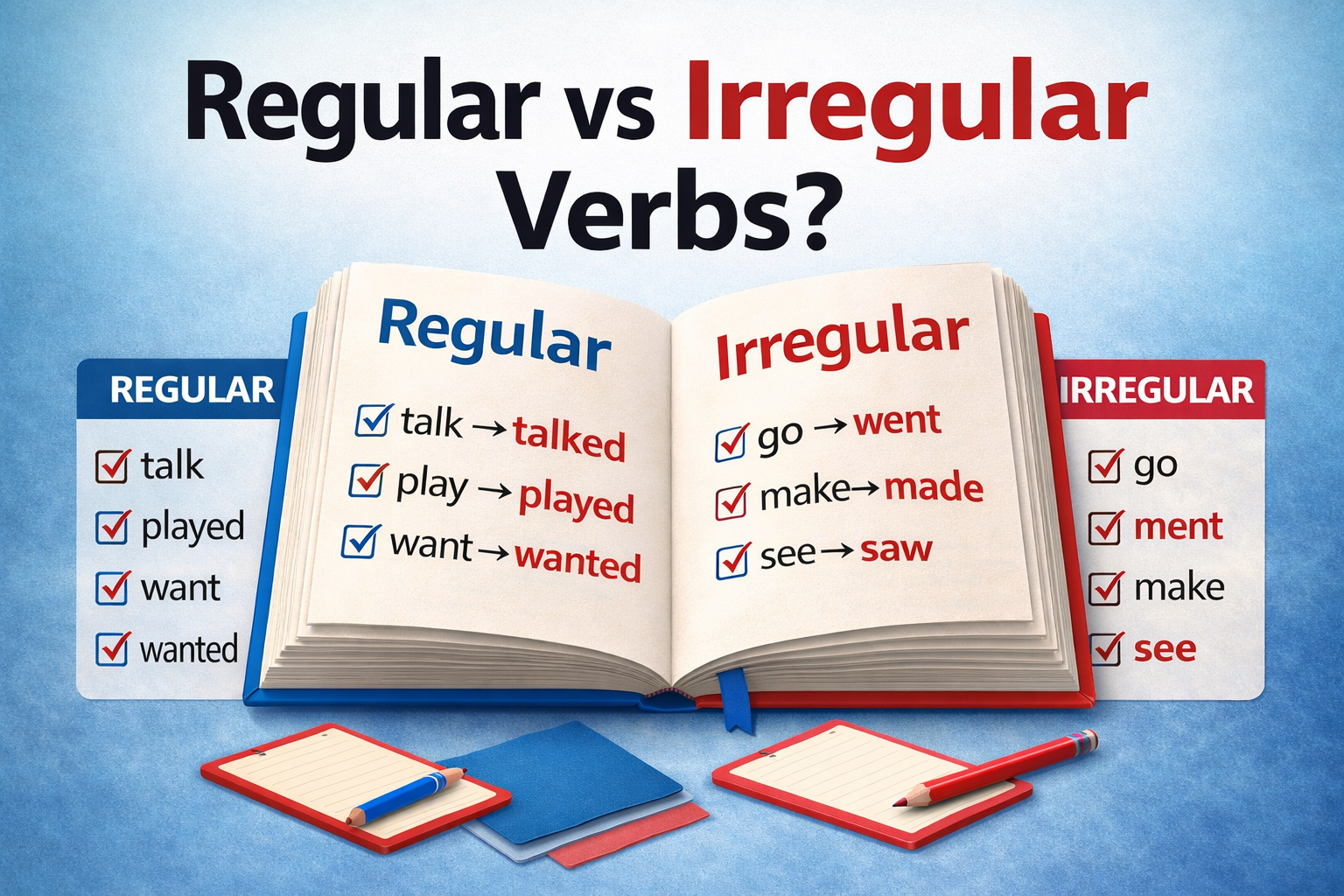
    Regular Verbs in English

    Regular verbs are the simpler group. They follow a clear and predictable pattern.

    To form the past simple and the past participle, we add -ed to the base form of the verb.

    Examples of regular verbs:

    • work → worked
    • play → played
    • study → studied
    • open → opened

    Regular Verbs in Sentences

    Here are some simple examples:

    Past Simple

    I worked in London last year.
    She played tennis yesterday.
    They studied English at school.

    Present Perfect

    I have worked here for five years.
    She has played this game before.
    They have studied a lot this month.

    Past Perfect

    I had worked there before I moved.
    She had played professionally before the injury.

    Notice that the verb form does not change. Regular verbs always use -ed for both the past simple and the past participle.

    That is why they are called regular.


    Irregular Verbs in English

    Irregular verbs do not follow the -ed pattern. Their past forms change, and there is no single rule that explains all of them.

    Examples:

    • go → went → gone
    • see → saw → seen
    • eat → ate → eaten
    • take → took → taken

    Because of this, irregular verbs usually appear in tables with three forms:

    1. base form (present)
    2. past simple
    3. past participle

    Where Irregular Verbs Are Used

    Irregular verbs are used in exactly the same tenses as regular verbs. The difference is only in the form, not in the grammar rule.

    Past Simple

    We use the second column (past simple).

    I went home early.
    She saw him yesterday.
    They ate at a restaurant.

    Present Perfect

    We use the third column, called the past participle.

    I have gone home.
    She has seen that movie.
    They have eaten already.

    Past Perfect

    Again, we use the past participle.

    I had gone home before the rain started.
    She had seen him before the meeting.
    They had eaten when we arrived.

    📌 Important:
    Both present perfect and past perfect always use the past participle, not the past simple.


    TABLE OF THE MOST FREQUENT IRREGULAR VERBS

    Complete List of Irregular Verbs
    Base Form Past Simple Past Participle
    be was / were been
    beat beat beaten
    become became become
    begin began begun
    bend bent bent
    bite bit bitten
    blow blew blown
    break broke broken
    bring brought brought
    build built built
    buy bought bought
    catch caught caught
    choose chose chosen
    come came come
    cut cut cut
    do did done
    draw drew drawn
    drink drank drunk
    drive drove driven
    eat ate eaten
    fall fell fallen
    feel felt felt
    find found found
    fly flew flown
    forget forgot forgotten
    get got got / gotten
    give gave given
    go went gone
    have had had
    hear heard heard
    keep kept kept
    know knew known
    leave left left
    lose lost lost
    make made made
    meet met met
    pay paid paid
    put put put
    read read read
    run ran run
    see saw seen
    sell sold sold
    send sent sent
    sit sat sat
    speak spoke spoken
    take took taken
    tell told told
    think thought thought
    understand understood understood
    wear wore worn
    win won won
    write wrote written

    This table is essential because irregular verbs must be learned individually. There is no shortcut.


    How to Learn Irregular Verbs (The Honest Truth)

    There is no magic trick for learning irregular verbs.

    They are learned through:

    • repetition
    • memorization
    • exposure
    • and, most importantly, sentences

    For example, learning went alone is difficult. Learning it inside a sentence is much easier:

    I went to work early today.
    She went home after class.

    The more you see and use these verbs in context, the more natural they become.


    A Very Common Student Mistake

    A common mistake is mixing the past simple and the past participle.

    Incorrect:

    ❌ I have went to London.

    Correct:

    ✅ I have gone to London.

    The mistake happens because the learner uses the second column instead of the third.

    Remember:

    • past simple → second column
    • present perfect / past perfect → third column

    How This Connects to Other Tenses

    Understanding regular and irregular verbs helps you:

    • form the past simple correctly
    • use the present perfect with confidence
    • avoid mistakes in the past perfect

    These ideas connect directly to the broader explanation in📘 Present Perfect Explained: When English Connects the Past to the Present


    Conclusion: Patterns vs Memory

    Regular verbs follow a pattern.
    Irregular verbs follow memory.

    Both are part of English, and both are necessary.

    Once you understand:

    • that regular verbs use -ed
    • that irregular verbs change form
    • and that perfect tenses use the past participle your grammar becomes clearer and more reliable.

    Source: British Council – Present Perfect grammar reference, WobbleMonkey – Present Perfect Tense with Regular Verbs, EF English Resources – Present Perfect and Past Participle Rules, GingerSoftware – List of Irregular Verbs in English, British Council – Irregular verbs reference

    Learn through English
    Share. Facebook Twitter Pinterest LinkedIn Tumblr WhatsApp Email
    Previous ArticlePresent vs Past Time: How English Organizes Time
    Next Article How Long Does It Really Take to Learn English Well?
    wilfordfluency
    • Website

    Related Posts

    What’s the Difference Between Storey and Floor?

    14 de January de 2026

    What’s the Difference Between City and Town?

    13 de January de 2026

    What’s the Difference Between Teacher and Professor?

    12 de January de 2026

    What’s the Difference Between Borrow and Lend?

    12 de January de 2026
    Leave A Reply Cancel Reply

    Recommendations

    Present Perfect vs Past Simple: Understand the Difference and Avoid Common Mistakes

    14 de December de 2025

    When to Use Neither, Either, Nor and Or: Guia Completo para Estudantes de Inglês

    11 de December de 2025
    More tips
    Grammar

    What’s the Difference Between Storey and Floor?

    By wilfordfluency14 de January de 20260

    What’s the Difference Between Storey and Floor? The words storey and floor are closely related,…

    What’s the Difference Between City and Town?

    13 de January de 2026

    What’s the Difference Between Teacher and Professor?

    12 de January de 2026

    What’s the Difference Between Borrow and Lend?

    12 de January de 2026
    About me
    About me

    Wilford Fluency é um site educacional criado por Márcio Wilford, professor de inglês com mais de 10 anos de experiência no ensino do idioma, focado no uso prático e real da língua inglesa.

    Recommendations

    Present Perfect vs Past Simple: Understand the Difference and Avoid Common Mistakes

    14 de December de 2025

    When to Use Neither, Either, Nor and Or: Guia Completo para Estudantes de Inglês

    11 de December de 2025
    New Comments
    • wilfordfluency on Take it easy: significado, uso e exemplos em inglês
    • Home
    • Expressions
    • English for Travel
    • Tricky English
    • Contact
    • About me
    © 2026 Wilford Fluency. Todos os direitos reservados | Política de Privacidade

    Type above and press Enter to search. Press Esc to cancel.

    Manage Consent
    To provide the best experiences, we use technologies like cookies to store and/or access device information. Consenting to these technologies will allow us to process data such as browsing behavior or unique IDs on this site. Not consenting or withdrawing consent, may adversely affect certain features and functions.
    Functional Always active
    The technical storage or access is strictly necessary for the legitimate purpose of enabling the use of a specific service explicitly requested by the subscriber or user, or for the sole purpose of carrying out the transmission of a communication over an electronic communications network.
    Preferences
    The technical storage or access is necessary for the legitimate purpose of storing preferences that are not requested by the subscriber or user.
    Statistics
    The technical storage or access that is used exclusively for statistical purposes. The technical storage or access that is used exclusively for anonymous statistical purposes. Without a subpoena, voluntary compliance on the part of your Internet Service Provider, or additional records from a third party, information stored or retrieved for this purpose alone cannot usually be used to identify you.
    Marketing
    The technical storage or access is required to create user profiles to send advertising, or to track the user on a website or across several websites for similar marketing purposes.
    • Manage options
    • Manage services
    • Manage {vendor_count} vendors
    • Read more about these purposes
    View preferences
    • {title}
    • {title}
    • {title}
    Ad Blocker Enabled! 😢
    Ad Blocker Enabled! 😢
    We understand ads can be annoying 😕 Still, they help us keep teaching English for free 🙏📚 Please consider disabling your ad blocker to help keep this content free.

    Sign In or Register

    Welcome Back!

    Login to your account below.

    Lost password?