

Conditional sentences are extremely important in English because they allow us to talk about real situations, hypothetical possibilities, and unreal events in the past. In general, they help us explain what usually happens, what might happen, or what could have happened under certain conditions.
First of all, it is important to understand that English has several types of conditional sentences. However, the most common ones are the zero conditional, the second conditional, and the third conditional. In the following sections, each type will be explained separately, using clear explanations and natural examples.
Zero Conditional – General truths and real situations
To begin with, the zero conditional is used to talk about things that are always true or that generally happen when a specific condition is met.
Structure
If / when + present simple, present simple
Examples
- If you heat ice, it melts.
- If it rains, we stay at home.
- When I drink coffee at night, I can’t sleep.
In these examples, both the condition and the result are real. Therefore, the zero conditional is commonly used to describe facts, habits, and general rules.
Moreover, it is worth remembering that “if” and “when” are often interchangeable in zero conditional sentences. In most cases, changing one for the other does not significantly affect the meaning.
Second Conditional – Unreal or hypothetical situations in the present or future
Now, let’s move on to the second conditional. This structure, however, is used to talk about situations that are not real in the present or that are unlikely to happen in the future.
Structure
If + past simple, would + base verb
Examples
- If I had more time, I would travel more.
- If she lived closer, we would see each other more often.
- If I were you, I would talk to him.
At first, this structure may seem confusing. After all, it uses the past simple tense. However, the second conditional is not about the past. Instead, it is used to describe imaginary situations, unlikely futures, or giving advice.
For this reason, the past tense here shows distance from reality, not past time.
Important note
In formal English, speakers usually say:
If I were you…
Rather than:
If I was you…
Third Conditional – Unreal situations in the past
Finally, we come to the third conditional. This conditional is used to talk about past situations that did not happen. In other words, it allows us to imagine a different past and a different result.
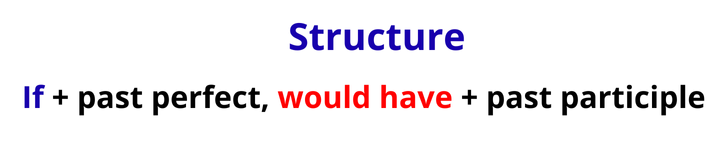
- If I had studied harder, I would have passed the exam.
- If we had left earlier, we wouldn’t have missed the flight.
- If she had known about the meeting, she would have come.
Generally speaking, the third conditional is often used to express regret or criticize past actions. As a result, it clearly shows that the past cannot be changed.
Common mistakes learners make
At this point, it is useful to look at some common mistakes. For example, many learners mix different conditional structures in the same sentence.
❌ If I would have more time, I would travel more.
✅ If I had more time, I would travel more.
❌ If I knew about it, I would have helped you.
✅ If I had known about it, I would have helped you.
In these cases, the main problem is that the verb tense does not match the situation. Therefore, each conditional must correctly reflect the time reference and the level of reality.
Final thoughts
In conclusion, learning conditional sentences is not just about memorizing grammar rules. Instead, it is about understanding how English expresses reality, imagination, and time.
To sum up:
- The zero conditional describes things that are always true.
- The second conditional describes unreal or unlikely situations.
- The third conditional describes unreal situations in the past.
Once you understand this logic, conditional sentences become much easier — and, more importantly, much more natural to use.
