

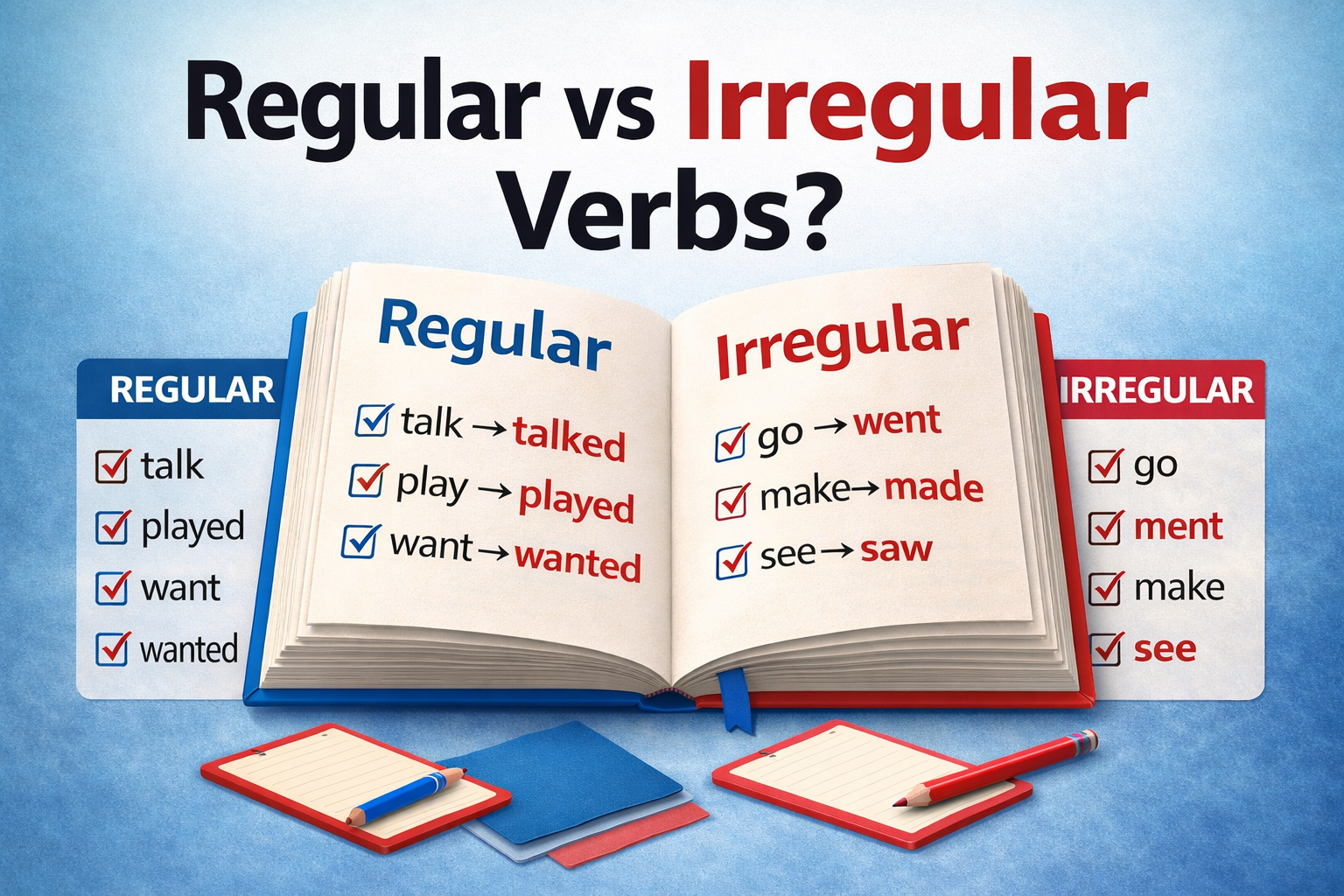
When we learn English, verbs are one of the first things we notice. Very early on, we realize that not all verbs behave in the same way, especially when we talk about the past or use perfect tenses.
In English, verbs are divided into regular verbs and irregular verbs. Understanding this difference is essential, because it affects how we form the past simple, the present perfect, and the past perfect.
This text explains both types clearly and shows how they are used in real sentences.
Regular Verbs in English
Regular verbs are the simpler group. They follow a clear and predictable pattern.
To form the past simple and the past participle, we add -ed to the base form of the verb.
Examples of regular verbs:
- work → worked
- play → played
- study → studied
- open → opened
Regular Verbs in Sentences
Here are some simple examples:
Past Simple
I worked in London last year.
She played tennis yesterday.
They studied English at school.
Present Perfect
I have worked here for five years.
She has played this game before.
They have studied a lot this month.
Past Perfect
I had worked there before I moved.
She had played professionally before the injury.
Notice that the verb form does not change. Regular verbs always use -ed for both the past simple and the past participle.
That is why they are called regular.
Irregular Verbs in English
Irregular verbs do not follow the -ed pattern. Their past forms change, and there is no single rule that explains all of them.
Examples:
- go → went → gone
- see → saw → seen
- eat → ate → eaten
- take → took → taken
Because of this, irregular verbs usually appear in tables with three forms:
- base form (present)
- past simple
- past participle
Where Irregular Verbs Are Used
Irregular verbs are used in exactly the same tenses as regular verbs. The difference is only in the form, not in the grammar rule.
Past Simple
We use the second column (past simple).
I went home early.
She saw him yesterday.
They ate at a restaurant.
Present Perfect
We use the third column, called the past participle.
I have gone home.
She has seen that movie.
They have eaten already.
Past Perfect
Again, we use the past participle.
I had gone home before the rain started.
She had seen him before the meeting.
They had eaten when we arrived.
📌 Important:
Both present perfect and past perfect always use the past participle, not the past simple.
TABLE OF THE MOST FREQUENT IRREGULAR VERBS
| Complete List of Irregular Verbs | ||
| Base Form | Past Simple | Past Participle |
| be | was / were | been |
| beat | beat | beaten |
| become | became | become |
| begin | began | begun |
| bend | bent | bent |
| bite | bit | bitten |
| blow | blew | blown |
| break | broke | broken |
| bring | brought | brought |
| build | built | built |
| buy | bought | bought |
| catch | caught | caught |
| choose | chose | chosen |
| come | came | come |
| cut | cut | cut |
| do | did | done |
| draw | drew | drawn |
| drink | drank | drunk |
| drive | drove | driven |
| eat | ate | eaten |
| fall | fell | fallen |
| feel | felt | felt |
| find | found | found |
| fly | flew | flown |
| forget | forgot | forgotten |
| get | got | got / gotten |
| give | gave | given |
| go | went | gone |
| have | had | had |
| hear | heard | heard |
| keep | kept | kept |
| know | knew | known |
| leave | left | left |
| lose | lost | lost |
| make | made | made |
| meet | met | met |
| pay | paid | paid |
| put | put | put |
| read | read | read |
| run | ran | run |
| see | saw | seen |
| sell | sold | sold |
| send | sent | sent |
| sit | sat | sat |
| speak | spoke | spoken |
| take | took | taken |
| tell | told | told |
| think | thought | thought |
| understand | understood | understood |
| wear | wore | worn |
| win | won | won |
| write | wrote | written |
This table is essential because irregular verbs must be learned individually. There is no shortcut.
How to Learn Irregular Verbs (The Honest Truth)
There is no magic trick for learning irregular verbs.
They are learned through:
- repetition
- memorization
- exposure
- and, most importantly, sentences
For example, learning went alone is difficult. Learning it inside a sentence is much easier:
I went to work early today.
She went home after class.
The more you see and use these verbs in context, the more natural they become.
A Very Common Student Mistake
A common mistake is mixing the past simple and the past participle.
Incorrect:
❌ I have went to London.
Correct:
✅ I have gone to London.
The mistake happens because the learner uses the second column instead of the third.
Remember:
- past simple → second column
- present perfect / past perfect → third column
How This Connects to Other Tenses
Understanding regular and irregular verbs helps you:
- form the past simple correctly
- use the present perfect with confidence
- avoid mistakes in the past perfect
These ideas connect directly to the broader explanation in📘 Present Perfect Explained: When English Connects the Past to the Present
Conclusion: Patterns vs Memory
Regular verbs follow a pattern.
Irregular verbs follow memory.
Both are part of English, and both are necessary.
Once you understand:
- that regular verbs use -ed
- that irregular verbs change form
- and that perfect tenses use the past participle your grammar becomes clearer and more reliable.
Source: British Council – Present Perfect grammar reference, WobbleMonkey – Present Perfect Tense with Regular Verbs, EF English Resources – Present Perfect and Past Participle Rules, GingerSoftware – List of Irregular Verbs in English, British Council – Irregular verbs reference
